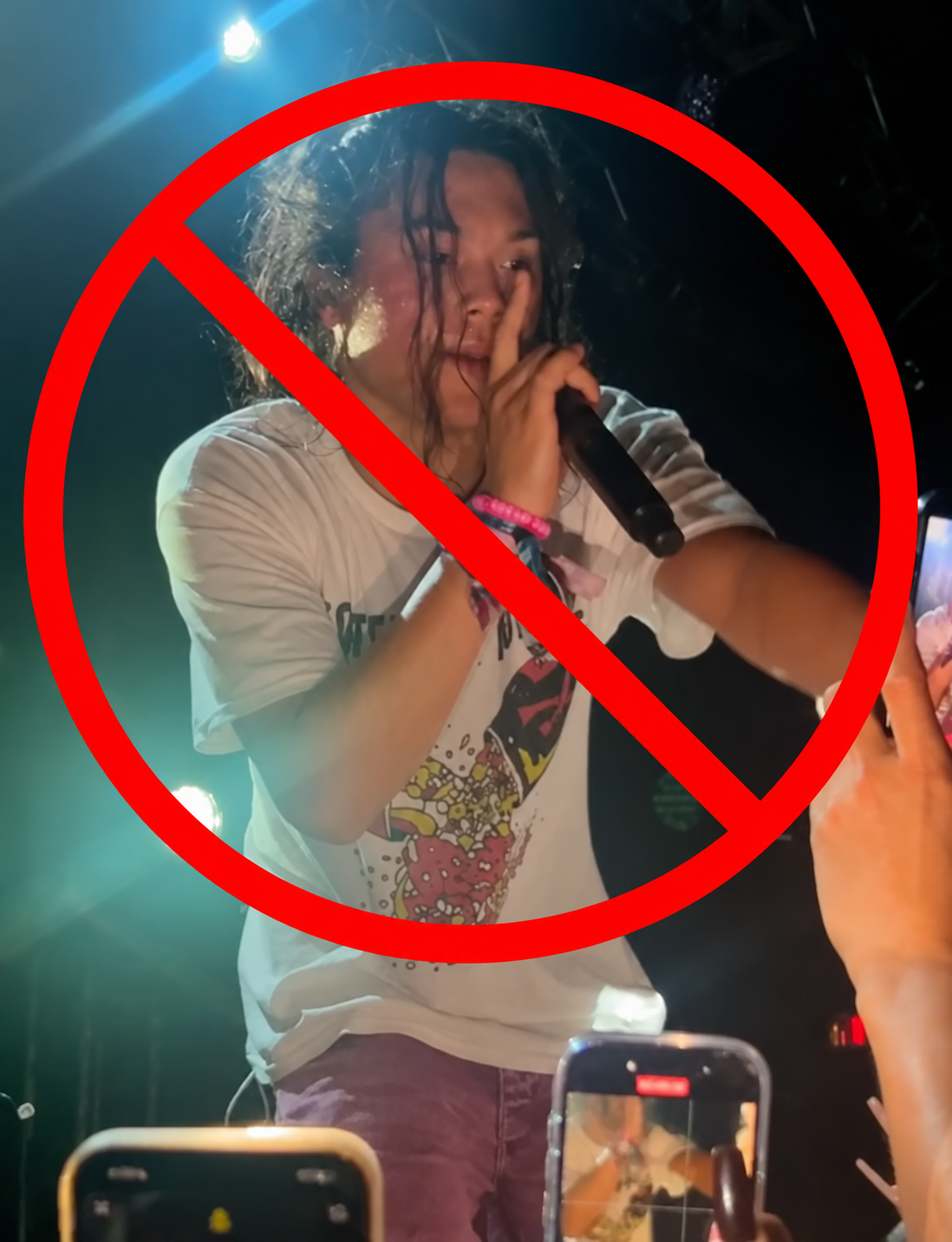
I was mid-way through my senior year of high school when I first listened to Feng. A friend, tapped into the underground music scene to a worrying degree, sent me “Walk in the park”. I was instantly drawn to it; the meaningless lyrics, the beat that never dropped. This started a dedicated appreciation for Feng, accompanied by the smug thought that I was early to an artist I had a strong suspicion would blow up and future-me could relish in bragging to my peers about my superior taste, artistic discernment, and prescient mind. One and a half years later, I can take comfort in knowing he did, in fact, blow up. However, now it’s something I’d rather not hold over the head of my peers. Somewhere along the way of his meteoric rise, Feng lost what initially drew me to him.
Feng decided appealing to early 2010s indie sleaze aesthetics was the way to go. This is, of course, not necessarily bad–one can genuinely enjoy the milieu from that time, and have it reflected in their art. However, are we supposed to believe this was an utterly pure, unclouded evolution in his music, and not an opportunistic, monetarily beneficial move? Capitalizing on a large portion of Gen-Z aged listeners' alienation from present culture and their desire to return to the abstracted early-to-mid 2010s is a shrewd business maneuver, but it is just that; a shrewd business maneuver. It is not a sign of artistic integrity, nor talent, nor, most of all, respect for his dedicated listeners.
Let’s say we ignore the dubious ethics of hinging your artistry on allusions to the virtue of the past, as the future is already a lost cause (which, in Feng’s case, is borderline manipulative)–Feng’s later music still does not deserve the success it has garnered. “Cali Crazy”, the opening song off his 2026 album Weekend Rockstar now sits at 5.4 million streams, and has 15.8k vids using it as a sound on TikTok. If you were even remotely interested in underground music when Weekend Rockstar dropped, you could not escape it.
Before even listening to the song, one can imagine where the song is going: vapid gestures at the supposed greatness and unmatched atmosphere of California. This is, of course, how the song ends up going. “Every day's a holiday / I might lose my own face goin' crazy in L.A / Every day, every day / Go insane, go insane”. Must we really pretend this is inspired work?
There is nothing wrong with lyrics that don’t mean anything–one needs only to listen to Cocteau Twins or Bladee to dispel the notion of lyrical ability equating to musical talent–but Feng doesn’t have any of the musical talent to justify his lack of lyrical ability. The entire song is delivered in a monotone register, backed up by what seems like the producer’s vaguely recollected impression of what they believe an early 2010s dance-pop song is supposed to sound like. This culminates in an exceptionally boring and, unfortunately, grating song. Now, if the opener of an album is any indication of how the rest of the album goes, what do you think the rest of the album sounds like? If you were to guess similarly boring and grating, you would be correct. “Best Friend” offers us “Now we chill on sofas, but it used to be the bed / She was like the Barbie to me and I was a Ken / She my Poison Ivy, but used to be medicine.” “Running Wild” opens up with “We don't really care what they all told us (Told us) / Young and dumb, we never wanna grow up (Grow up) / We live for ourselves, we wanna blow up (Blow up, yeah)”. “Dopest Girl”, Weekend Rockstar’s penultimate song, has “So she pull up late, chill on the roof / Talk 'bout things that we go through / She's a soldier in a dress / She's a girl but like a dude”. “She’s a girl but like a dude”? Really? Are we serious?
Feng’s latest album, Summer at Camp Lakepine, released in August. Before listening, one may hope that Feng offers us something fresh; after listening, one must resign oneself to Feng being a lost cause. The only notable thing in Summer at Camp Lakepine is his move away from the contrived impressions of early 2010s electropop plaguing Weekend Rockstar, replacing it with the cloud rap beats he sounds much more comfortable on. However, even then, it still doesn’t make up for the sheer mind-numbingness of Summer at Camp Lakepine. Every song is a hagiography for Southern California (“Coachella” says “Palm Springs, Coachella / Do you wanna be my desert Cinderella?”) or nauseatingly insistent on the futility of teenage love (“Lets Make Out” says “It was lust, never love / She don't even look at me the same / I thought that we fit just like a glove / But she forgot 'bout it next day”). How much can one take of Feng talking about the same thing, over and over and over again? Now, none of the lyrical criticism would matter if Feng seemed the least bit interested in introducing some variety into his music–but he doesn’t! It seems as if Feng realized he stumbled upon a profitable formula, reproducing indie songs from the 2010s while speaking about how great teenage life is, and bet the house on it; we are now seeing this bet dissolve in real time. Clearly, Feng doesn’t have much to offer beyond shallow praise for L.A. and its peripheries, banal platitudes about teenage life, and nostalgia-bait deployed to cover up his glaring inability to come up with anything original.
Feng’s shortcomings become much more apparent when you compare him to another artist of similar age, similar locale, and similar rate of rise, Fakemink. I profess I am slightly biased; I have a tendency to pontificate about the excellence of Fakemink to anyone readily available to sit through my schpiel, routinely play his music in social settings ad nauseam, and truly believe “Wookies” is one of the best songs of all time. However, this is not without reason. Fakemink’s (mostly) nonsense lyrics are justified through his unique, intoxicating production and a resolute artistic identity cultivated through years of musical experimentation. Fakemink was posting music for years under the name “9090gates" on Soundcloud, offering us a look into his artistic evolution. When he changed his name to Fakemink, he continued to release music at an astonishing rate; 70 singles in 2024, and 4 albums along with 45+ singles in 2025.
Now, Fakemink is not without his issues. His music is, at times, repetitive, and he has a predilection for grandiose statements that indicate an inflated self image (Via Instagram Live in 2025, Fakemink stated he is “barely a rapper”, but instead “an artist bro”, and followed it up with “I’m better than every rapper...when I say every rapper, I mean every single rapper bro, dead or alive”. Both statements were met with the appropriate widespread criticism)–but he represents a true, unwavering commitment to his artistry. In short, Fakemink is everything Feng is not.
If there is any praise I have for Feng, it is that he is a talented marketer (accordingly, he has now taken to being an amateur party promoter, frequently posting overviews of parties he’s hosting across his social media). He figured out that by cultivating an appealing, but entirely hollow, aesthetic for impressionable young teenagers, his lackluster music could be willfully forgotten. In that sense, Feng is more a concept, an idea, than a musician; one listens to him to signal their allegiance to an idealized past and an unencumbered, youthful indulgence in Fun. Of course, that is the listener’s prerogative–one can hardly blame someone for wanting to escape the panoptic, hyper-transactional mode of life that characterizes contemporary culture to the ostensibly Edenic, unmonitored, carefree times of the early 2010s that Feng promises–but what can we say about the artist that benefits from that desire?
Making contemptuous fun of Feng is supremely easy: his laughably inane lyrics without the melodic sophistication to back it up, his fanbase of adolescents incessantly proclaiming their desire to return to a time in history they were barely cognizant of until six months ago, their want in becoming an “L.A. P.O.S.” (Los Angeles piece of shit, a questionable aspiration), their superior “swag”, the value inherent in how “niche” they are, all while posting TikToks with any one of his songs playing in the background that point to the greatness of shunning responsibilities and uninhibited youth. However, I can’t help but feel sympathy for him and his fans in a sort of recursive way. Feng only exists because of his largely annoying fans, and his largely annoying fans only exist because of Feng. What further complicates things is I am implicated in his rise; I was the one who, 18 months ago, took self-indulgent pleasure in knowing he would blow up, and now I have to face the discomfiting reality that perhaps my artistic discernment wasn’t so discerning after all.